Comparing Kansas State Parks for Camping: Shade, Scenery, Access
Choosing a Kansas state park for camping is not just a choice between lakes or landscapes. A site that looks scenic may offer little afternoon shade, while a convenient campground may be far from the views or activities you want. Compare the actual campground loops, site details, and drive before you commit, and you’ll have a better chance of finding a stay that fits your rig, comfort needs, and plans.
Start with the campground, not the park name
A park’s overall character can help you narrow your options, but it does not tell you what a particular campsite will feel like. Shade, views, road access, and the distance to facilities can vary across one park. For a useful comparison, look at the campground and site you might use—not just a photo of the park or a broad description of its scenery.
Think about three kinds of access:
- Getting to the park: How far will you drive from your route, and are you comfortable with the roads and travel time?
- Getting to your site: What do the campground map and site description show about the approach, turning space, and position within the loop?
- Getting around after setup: How close will you be to the places you want to visit, such as the water, a trail, or shared facilities?
These are separate questions. A park may be easy to reach by car, yet a particular campsite may be inconvenient for a large trailer. A site may be close to the lake but have little shade or be exposed to wind. Another may offer more cover but require a longer drive or walk to the activity you care about.
Use the official park information and campground map to make a shortlist. Check whether descriptions refer to the whole campground or to individual sites, and look for the map’s scale and legend. If the map does not answer an important question—such as whether a site is level enough for your setup or how much room there is to turn—contact the park using the current details on its official website.
If you are still deciding what kind of place to stay in, compare Choosing a Campsite Type in Kansas State Parks, Primitive to Utility. A campground’s general setting and service level can change the trip as much as the park’s scenery.
What different Kansas park settings can offer
Many Kansas state park camping trips are organized around a lake. The water can be the main reason to choose a park, but the shore does not guarantee a waterfront campsite, a view from your site, or a short walk to the activity you have in mind. Campground maps and site descriptions are the better tools for checking those details.
Three named parks provide useful examples of how to think about setting without assuming every campsite offers the same experience:
| Park | Broad setting to consider | What to verify before choosing a campsite |
|---|---|---|
| El Dorado State Park | A lake-centered stay near El Dorado Reservoir | Which campground area fits your plans, whether a particular site has the shade or view you want, and the route between the site and your activities |
| Cross Timbers State Park | A stay near Toronto Lake | The exact campsite location, the access route for your vehicle, and the distance from the site to the places you plan to use |
| Fall River State Park | A lake-centered stay near Fall River Lake | The setting of the specific loop, how much tree cover the chosen site appears to have, and whether the site suits your equipment |
These are starting points, not a ranking. They do not establish which park has the most shade, the best view, or the easiest campground road. Those answers depend on the specific campsite, the season, and what counts as convenient for your trip.
If you want a view, decide what kind. “Scenic” might mean open water, a tree-lined edge, a broad horizon, or a quiet setting away from a busy recreation area. A view from the campsite is different from a view you reach after a short walk or drive. When campsite photos are available, use them as clues rather than guarantees: images can show a different season, angle, or nearby site.
If the lake itself is the priority, ask whether you want to look at the water, spend time beside it, or use a particular access point. A campsite near a shoreline on a map may not mean that you can reach the water directly from the site. Likewise, a park close to a lake does not mean that every campground is lakeside.
For a broader comparison of scenery and outdoor settings, see Lakeside or Prairie: Choosing Between Kansas State Parks. It can help clarify which landscape suits your trip, while the campground map helps you assess the particular stay.
How to judge shade before you choose
Shade can make a campsite more comfortable, especially during hot weather, but it is easy to overestimate from a park-wide description or one photograph. The amount of cover around a particular site matters more than whether a park has trees somewhere on its grounds.
Look at several clues together:
- Canopy in site photos: Check how much of the campsite is covered and whether the branches appear to shade the area where you will sit, sleep, or park.
- Tree placement: Trees near the edge of a site may not shade the tent, RV, or picnic area during the hottest part of the day.
- Loop layout: Open spaces between sites may provide less cover than a wooded section, but the map alone may not show how much foliage is present.
- Orientation: A site’s direction and nearby trees affect when shade falls across the camping area. A photo taken in the morning may not show the afternoon conditions.
- Season and recent conditions: Leaf cover changes during the year, and storms or other maintenance may alter what a photo suggests.
A satellite view can add context, but it is not a measurement of shade. Trees may be outside the site boundary, foliage may be thin, and an overhead image cannot show how the canopy blocks the sun at ground level. Use it to identify areas worth checking, then compare it with the campground map and available site images.
When you need shade for comfort, avoid treating “wooded” as a guarantee. Look for evidence that the actual site has useful cover. If you cannot confirm it, plan as though the site may be more exposed than expected. A shade canopy, suitable clothing, drinking water, and a plan for hot weather can make the trip less dependent on the tree cover being exactly as pictured.
Shade also involves trade-offs. Trees can make a site feel cooler and more sheltered, but a shaded campsite may have a more limited view or less open space. Dense cover can also make it harder to judge the site’s layout from online photographs. If your priorities include both shade and a wide view, compare several sites instead of expecting one campsite to provide everything.
For seasonal planning, Summer Camping in Kansas State Parks: Heat, Shade and Storms offers more detail on preparing for warm conditions. Do not rely on tree cover as your only heat plan, especially if your group includes children or anyone who may be more affected by high temperatures.
Match the campsite to your tent, trailer, or RV
A park can be a good match for your trip and still have a campground that does not suit your equipment. Before choosing a site, compare the site description with the full footprint of your camping setup. That includes the vehicle, trailer or RV, tow vehicle, slide-outs, steps, awning, and any other gear you expect to use.
Start with the dimensions and access details the official listing provides. If you are traveling with an RV, measure the complete setup rather than relying on the length listed for one component. A site description may not answer every question about approach, turning space, slope, or clearance, so ask the park if a detail could affect whether you can use the site safely.
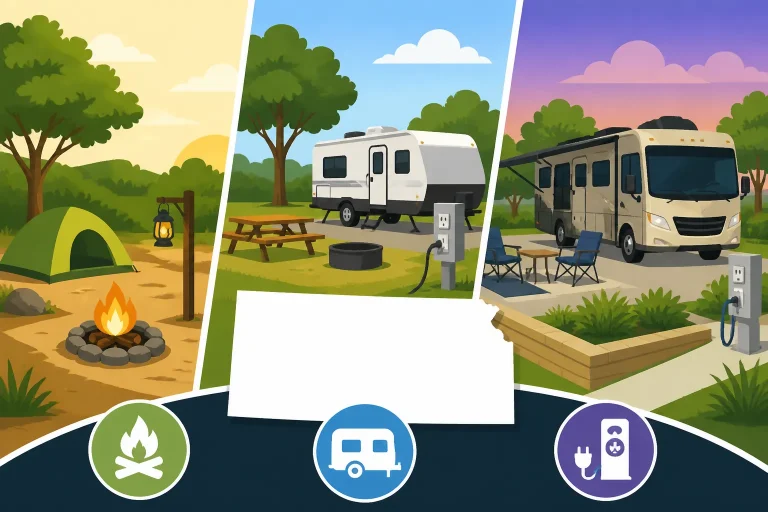
The distinction between site types matters, too. A primitive site and a utility site can offer different levels of service and different practical considerations. Do not assume that a site’s appearance, nearby amenities, or proximity to other campers tells you what hookups it has. Confirm the site’s listed features before choosing it. Utility Campsite Levels in Kansas State Parks, Compared and What Do You Get at a Primitive Campsite in a Kansas State Park? can help you decide what level of facilities suits your group.
| Your setup or priority | Details to compare | Useful next step |
|---|---|---|
| Tent | Tent area, ground cover, shade, and distance to shared facilities | Check site photos and confirm how the site is described |
| Travel trailer | Listed site dimensions, approach, turning room, and vehicle arrangement | Compare the site with the entire tow-and-trailer setup |
| Motorhome | Site length, access route, turning space, and available services | Measure the rig, including anything that extends when parked |
| Camper van | Site type, surface, access, and whether the listed amenities meet your needs | Check the site description rather than assuming every camping area is alike |
| Group with different equipment | Site capacity, layout, and whether everyone can stay together as planned | Verify the allowed arrangement and any relevant site conditions |
For a general overview of RV considerations in Kansas state parks, see RV Camping in Kansas State Parks: Matching Your Rig to a Site. If the question is whether a specific rig will fit, Will Your RV Fit? Checking Kansas State Park Campsite Sizes is a more focused reference.
Comfort and convenience can pull in different directions. A site near a facility or activity may save walking, but it may also see more foot traffic. A more tucked-away site may feel quieter but require extra planning for supplies or shared facilities. A site with open space may be easier for a larger setup, but less shaded. Decide which trade-off matters most to your group before comparing individual sites.
Compare access as part of the scenery
A beautiful setting is less useful if reaching the campground or getting around the park is a poor fit for your trip. Access includes more than the drive to the entrance. Consider the route to your campground, the shape of the loop, where you will park, and how far you will travel once you are settled.
If you are arriving with a trailer or a large RV, check the campground map and site information before choosing. Look for the roads leading to the loop and any site details that could affect turning or positioning. Do not assume that an easy route to the park means every site is equally easy to reach. If a map or listing leaves you uncertain, contact the park through its official website and ask a specific question about your setup.
For a tent camper, access may be more about where you will carry equipment, park, or walk to facilities. For a family, the distance between the site and the day’s activities may matter more than driving time from the entrance. For anyone who wants to spend time near the water, confirm whether the intended access point is close to the campground you are considering.
A few practical questions can reveal whether a site’s location works for you:
- How long is the drive from your planned route to the park?
- Which campground area best fits the activities you want to do?
- Does the route to the site appear suitable for your vehicle and equipment?
- How far is the site from the places you plan to visit?
- Does the route involve more walking or carrying than your group wants to manage?
- Are there current closures or updates that could affect the approach or planned activities?
Check official updates close to departure and again before you arrive. Conditions and access can change, and old trip reports or saved screenshots may not reflect current operations. Is Your Kansas State Park Open? Checking Closures and Updates and Where Kansas State Parks Post Operating Updates explain how to check for changes.
If you have flexibility, travel timing can also affect how accessible a park feels. Weekdays and weekends may differ in traffic and campground activity, but the exact experience depends on the park and date. Weekday Versus Weekend Camping at Kansas State Parks can help you weigh timing as part of the choice.
Choose based on the trip you want
Rather than looking for one park that is “best,” rank your own priorities. A short list helps prevent a scenic photo, a familiar name, or a convenient route from distracting from the practical details that matter for your stay.
For a shaded, comfortable campsite
Put individual site cover first. Compare photos and maps, and look for signs that trees shade the place where your group will spend time—not just the nearby road or the edge of the site. If the listing does not show the canopy clearly, ask whether the park can clarify what the site is like. Keep a backup plan for heat rather than assuming the campsite will provide enough shade.
For an open view or lakeside feel
Decide whether you want a view from the site, convenient access to the water, or simply a park where the lake is part of the visit. Then check the chosen campground’s location and the relationship between the site and the places you want to see. A park’s lake setting is not the same as a guaranteed lake view from every campsite.
For a large RV or trailer
Make equipment fit the first filter, not the last. Check the site dimensions and campground route, and compare the listing with the entire rig. A park may be appealing, but an unsuitable site can turn arrival into a stressful problem. When details are unclear, confirm them with the park before making plans.
For a tent-first trip
Compare ground conditions, shade, site spacing, and how far you will carry gear. Consider the services your group needs and whether a more basic site is a good match. See Tent Camping in Kansas State Parks: Primitive Loops and Quiet Nights for additional considerations.
For a family or mixed-interest group
Balance location with the needs of everyone who is coming. A site that makes it easy to reach the planned activities may be worth more than the most dramatic view. Think about walking distances, equipment, meal setup, weather, and how much time the group will spend at the campsite itself. If you are choosing for a family, Family Camping in Kansas State Parks: Picking Sites for Kids can help you plan around children’s needs.
For a quiet, slower-paced stay
Consider the loop’s position and what sits nearby. A site with easy access to a popular activity may also have more people moving through the area. A less central location could feel more restful, but it may mean more driving or walking. Do not treat “quiet” as a fixed feature unless current information supports it; campground activity varies.
A practical shortlist and final check
Once you have a few possible parks or campgrounds, compare them using the same questions. This makes the choice less dependent on whichever listing has the most appealing image.
| Question | Why it matters |
|---|---|
| What is the main landscape or activity I want? | It separates the park’s overall appeal from the needs of the campsite |
| Is the site shaded where my group will spend time? | Tree cover elsewhere in the park may not help at your site |
| Does the site give the view or water access I expect? | A lake-centered park does not guarantee a lakeside campsite |
| Does the site fit my tent, trailer, or RV? | Site dimensions and approach can affect whether your setup is practical |
| How far is the campground from our planned activities? | Convenience depends on the location of the actual loop |
| What services are listed for this site? | Site types and amenities can differ within a campground |
| Are there current updates that affect the trip? | Closures and operating changes can alter access or plans |
After you narrow the list, verify each detail in the official information for the park and site. Read the description carefully, review the current map, and check any available photographs. If your plans rely on a detail that is not clear—such as usable shade, turning room, or the walking distance to an activity—ask the park directly rather than guessing.
Also check the rules and practical requirements that apply to your stay. Vehicle permits, campsite fees, and site-specific details can affect the total plan, so confirm current information with the provider. Vehicle Permits and Camping Fees at Kansas State Parks, Explained covers the basic distinction between those costs and the campsite choice.
Before you leave, save the relevant campground map and current information in a way you can access on the road. Confirm that your selected site still suits your equipment and group, and review park updates again before arrival. A last-minute change in weather, access, or operating status may mean adjusting the plan. If you need to change your campsite or park, use the official reservation system or contact the park using its current website information.
The best fit is usually the campsite that meets your non-negotiables, not the one that wins every category. If shade matters most, prioritize evidence of useful cover. If your RV is large, settle the fit question first. If scenery is the reason for the trip, be precise about the view or access you want. A careful site-level comparison turns “Which park looks best?” into a decision you can plan around.
Frequently Asked Questions
Which Kansas state park is best for camping?
There is no single best choice for every camper. Compare the campground setting, individual site shade, vehicle access, facilities, and distance to the activities you have in mind.
Do Kansas lake parks guarantee a campsite with a lake view?
No. A park near a lake does not mean that every campground or campsite has a water view or direct access. Check the campground map and the description for the specific site.
How can I tell whether a campsite will have enough shade?
Review site-level photos and maps, paying attention to where the trees are in relation to your tent, RV, and sitting area. If the information is unclear and shade is important, ask the park for clarification and plan for the possibility of an exposed site.
What should RV campers check before choosing a park?
Compare the listed site dimensions and route to the campground with the full size of your rig. Confirm the site’s services and ask the park about any access detail that could affect your setup.
Disclaimer
This article is for general informational purposes only and does not constitute professional advice. Laws, prices and regulations vary by location and change over time. Consult a qualified professional for guidance on your specific situation. Kansas Camping & RV is not a government agency and is not affiliated with any government agency.