Utility Campsite Levels in Kansas State Parks, Compared
Kansas State Park utility-site labels can be confusing when you are comparing a basic electrical connection with a site that offers more hookups. The right choice depends on your camping unit, how you use water and wastewater facilities, and what the specific listing confirms. Here’s how to compare the levels and check the details before choosing a site.
What the utility-site labels tell you
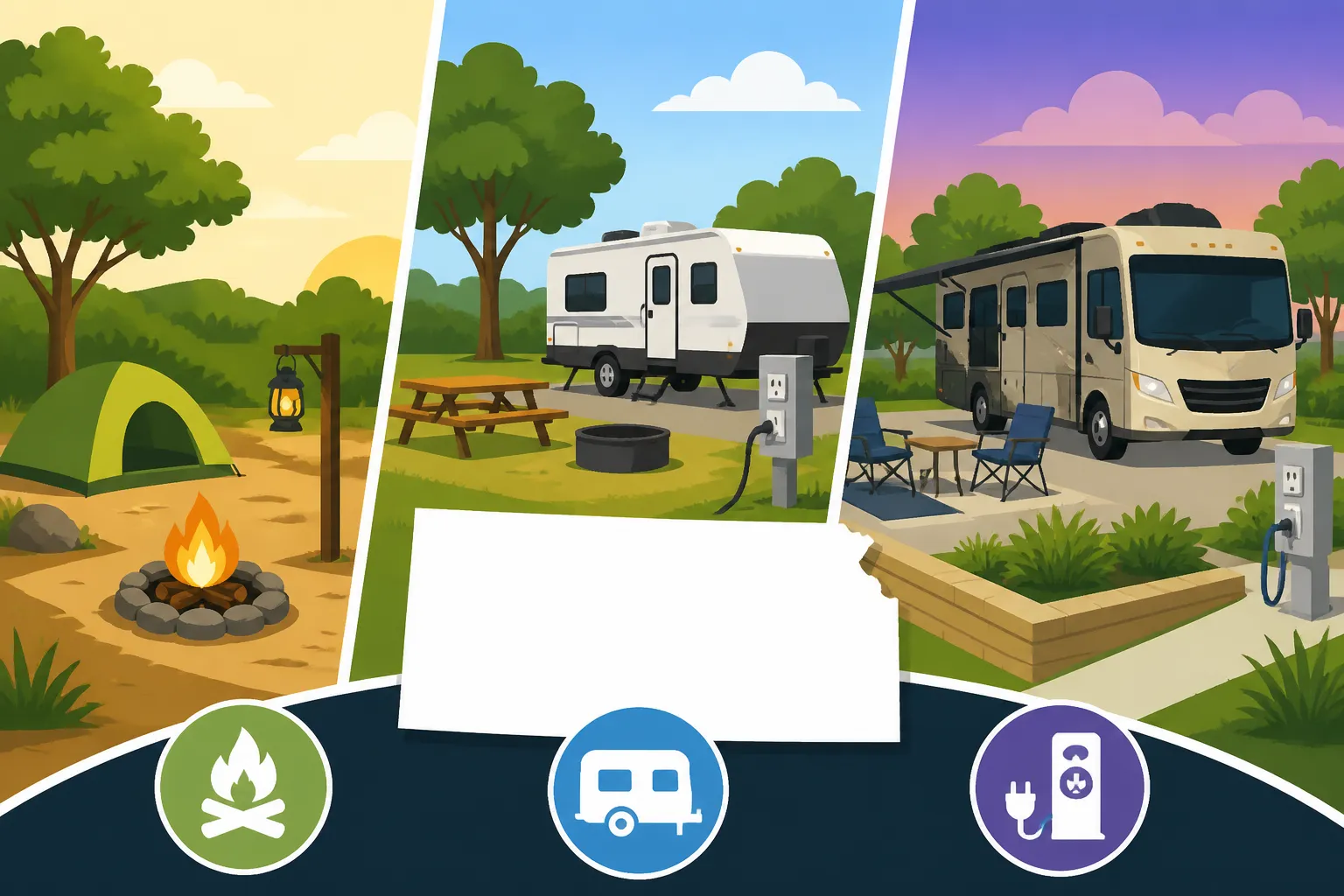
Utility-site names are a useful first filter, not a complete description of every campsite. In general, an electric site signals an electrical connection; a water/electric site signals those two kinds of service; and a full utility site suggests a broader set of hookups. The labels help narrow your search, but the park’s listing is the place to verify what a particular site provides.
| Site label | What the label generally suggests | What to verify before choosing |
|---|---|---|
| Electric utility | An electrical connection | Whether the site’s power service suits your equipment and how the site is configured |
| Water/electric utility | Water and electrical service at or for the site | Where the water connection is, how you will manage wastewater, and whether your hose and cord can reach |
| Full utility | A broader set of utility connections | Which services are included at that exact site, including how wastewater is handled |
These are helpful distinctions, but don’t treat the label as a promise about every detail. Sites within a campground may differ in layout, access, hookups, and nearby facilities. Read the current campsite description and confirm the details with the park if anything important is unclear.
At Cross Timbers State Park, the Kansas Department of Wildlife and Parks lists 19 full utility sites. The department also lists 50 water/electric utility sites there. For the electric category, the Kansas Department of Wildlife and Parks lists Cross Timbers State Park as having 8 electric utility. Together, these figures show that the park has three utility categories; they do not tell you which individual site will fit your equipment or needs.
A utility label also does not tell you everything about the camping experience. It does not, by itself, describe the site’s shade, surface, slope, privacy, distance to facilities, or space for your vehicle and camping unit. If those factors matter, compare the campsite descriptions and maps as well as the utility type. For broader site selection, see Choosing a Campsite Type in Kansas State Parks, Primitive to Utility and Which Kansas State Park Site Fits Tent, Trailer or Cabin Campers?.
How the three levels differ in practice
Electric utility sites
An electric utility site is a reasonable starting point when electrical service is the main hookup you need. It may suit a tent camper using powered equipment, or a trailer or motorhome that can manage water and wastewater without a direct connection at the site. The key is matching the listing to your actual setup rather than relying on the category name alone.
Before you choose one, consider what you will run from the electrical connection and whether your equipment is compatible with the site’s service. Check the campsite details for the connection information, and confirm it with the park if the listing does not answer your question. Do not assume that every electric site has identical service or a layout that will work equally well for every camping unit.
Water use is another important part of the decision. If the site does not have a water connection, think through how you will bring, store, and refill water during your stay. A nearby water source, if available, is not necessarily the same as a connection at the campsite. Check the park listing and plan for the arrangement it describes.
Wastewater needs also matter. An electric-only site does not imply a sewer connection. A campground may have other facilities, but their location and availability are separate questions from the site’s utility label. Check the park’s information for dump-station details and plan how you will manage wastewater. RV Dump Stations and Wastewater Rules at Kansas State Parks covers the distinction between campsite hookups and wastewater facilities.
Water/electric utility sites
A water/electric utility site is often a middle option for campers who want a water connection and electrical service but do not require every utility directly at the site. It can reduce the need to carry or refill as much water compared with a site without water service. It does not, however, automatically settle how you will handle wastewater.
For a trailer or motorhome, assess where the connections sit in relation to your vehicle’s inlets and outlets. A site description may give useful layout information, but when it does not, ask the park how to confirm that your hoses and cables can reach safely. Your equipment’s setup and the site’s arrangement both matter.
Tent campers may also find water/electric service useful, but should think about how they will use it. A connection may be convenient for certain gear or water needs, yet the site’s surface, shade, spacing, and location may matter more to the overall trip. Utility level is only one part of campsite suitability.
Water/electric sites are not necessarily interchangeable with full utility sites. If your camping unit depends on wastewater hookups, verify that the listing specifically describes the service you need. A dump station elsewhere in the campground can be useful, but it is not the same as a sewer connection at your site. For more on site selection with a tent, see Water and Electric Sites at Kansas State Parks for Tent Campers.
Full utility sites
A full utility label generally indicates a broader set of campsite services than electric-only or water/electric categories. Campers who want to connect more of their equipment at the site may find this category worth checking first. Still, confirm the exact connections in the current listing rather than assuming that “full” means the same configuration at every park or site.
For an RV, compare the site’s listed services with the utilities your vehicle actually needs. Check that the site can accommodate your rig and that the connection arrangement suits its layout. If you are unsure whether a specific site will work, ask the park before making a reservation. Will Your RV Fit? Checking Kansas State Park Campsite Sizes can help with the separate question of campsite dimensions.
For tent campers, a full utility site may offer more service than needed. That can be a worthwhile trade if the location or availability is a better fit, but a higher utility level is not automatically a better campsite. Consider whether you will use the connections and compare practical factors such as access, shade, nearby facilities, and the space you need.
The term “full utility” should not be used as a substitute for checking the wastewater details. Confirm which connections the park lists for the specific site and whether the arrangement matches your equipment. For a closer comparison of hookup labels, see What Do Full and Water-Electric Hookup Labels Mean for Your RV?.
Choose a site by matching services to your setup
Start with the camping unit and its needs, then use the utility category to narrow the options. The best match is the site that offers the services you will use and fits your equipment, rather than the category that sounds most complete.
- List the connections you need. Note whether you require electrical service, water at the site, wastewater service at the site, or some combination. Include any equipment that depends on electricity.
- Check the campsite listing. Read the details for the individual site or site type, not only the campground’s general description. Confirm that the listed connections match your needs.
- Compare the physical fit. Check the site dimensions and layout against your camping unit, vehicle, and equipment. Utility availability does not guarantee that a site is large or easy to maneuver into.
- Plan for water and wastewater. If water is not connected at the site, decide how you will carry or obtain it. If there is no wastewater hookup at the site, check the park’s information about other facilities and plan accordingly.
- Ask about unresolved details. If the listing leaves a critical point uncertain, contact the park through its official website before booking. A quick confirmation can prevent arriving with equipment that cannot use the site as expected.
For a tent, basic electrical access may be enough if you need power, while a no-hookup or lower-utility site may suit a simpler setup. Water/electric can be useful if having water nearby is important to your routine. A full utility site might make sense when you can use its additional connections, but it may not offer a better location or more convenient layout. Compare the complete listing, not just the utility name.
For an RV, start with the manufacturer’s utility requirements and your travel habits. If your system depends on a site connection, prioritize confirming that connection. If you can manage some needs without a direct hookup, a lower utility level could still work. Consider how often you want to refill water or use campground facilities, and whether your trip plans make those tasks easy or inconvenient.
For a camper van or small trailer, think about how the vehicle’s built-in systems affect your choice. A compact setup may not require the same connections as a larger RV. But compact size alone does not answer whether a campsite’s utility arrangement is compatible with the vehicle. Confirm the details that matter to your equipment.
Other campsite features can outweigh the utility level. A site that is easier to reach, better suited to your tent or rig, or closer to a facility you expect to use may be more practical than one with more connections. Compare site types and campground loops as well as hookups; Comparing Kansas State Parks for Camping: Shade, Scenery, Access offers a wider framework for weighing those considerations.
Booking and arrival checks that prevent surprises
Utility details are most useful when checked before you reserve. A campground overview may describe several categories, while the reservation listing may identify the specific site available for your dates. Read both, then compare the individual site’s description with your requirements. If booking systems or park listings use slightly different labels, focus on the services explicitly described.
When comparing available sites, note which details are confirmed and which you still need to ask about. For example, you may know the site category but still need to confirm the location of connections, the dimensions, or whether a listed utility works with your equipment. Keep a short checklist so you can compare options consistently rather than choosing based on a label alone.
Reservation records are also worth reviewing after booking. Make sure the selected site or site type matches what you intended, and retain the confirmation details you need for arrival. If you change sites or dates, review the new listing again; a different campsite may have a different utility category or layout. For the booking process, see Booking a Kansas State Park Campsite: Accounts, Payment and Renters.
Before leaving, check for operating updates that could affect your plans, such as closures or changes to facilities. Use the official park information and confirm any question that could affect your ability to use a hookup. Is Your Kansas State Park Open? Checking Closures and Updates explains what to look for before a visit.
On arrival, follow the directions and posted information for your campsite. Confirm that the site you are using is the one assigned or reserved, and check the connection setup before positioning your equipment. If the actual site appears different from what the listing described, speak with park staff rather than improvising with a connection that may not fit your equipment.
It is also sensible to plan for the possibility that a particular site will not work as expected. Keep your water and power needs in mind, and know what facilities or alternatives the park identifies. A little preparation is especially helpful when traveling with equipment that has strict power, water, or wastewater requirements.
Frequently Asked Questions
Does a full utility site always mean sewer service at the campsite?
Treat the label as a starting point and confirm the exact connections in the individual site listing. If sewer service at the site is essential, ask the park to verify that detail before booking.
Is water/electric enough for an RV?
It depends on the RV’s systems and how you plan to manage wastewater. Check which services the specific site lists and whether the arrangement works for your vehicle.
Can a tent camper use a utility site?
A tent camper can compare utility sites if the listed services suit the trip, but the campsite’s location, surface, and space matter too. Check the individual site details before choosing.
Which utility levels does Cross Timbers State Park list?
The Kansas Department of Wildlife and Parks lists full utility, water/electric utility, and electric utility categories at Cross Timbers State Park. Compare the specific site descriptions to determine which one fits your setup.
Sources
- Kansas Department of Wildlife and Parks — Campgrounds and Camping Reservations – Kansas Parks and Tourism (checked November 24, 2026)
Disclaimer
This article is for general informational purposes only and does not constitute professional advice. Laws, prices and regulations vary by location and change over time. Consult a qualified professional for guidance on your specific situation. Kansas Camping & RV is not a government agency and is not affiliated with any government agency.