New to Kansas State Parks? Permits, Campsites and Rules to Know
A first Kansas state park trip can raise practical questions: which permit covers the vehicle, where camping is allowed, and what kind of site fits your plans. The safest approach is to treat park entry, overnight arrangements, and local rules as separate things to verify. This guide explains how to plan those pieces, compare campsite options, and prepare for arrival without assuming every park works the same way.
Start by separating park entry from overnight plans
A vehicle permit and an overnight arrangement answer different questions. The permit concerns bringing a motorized vehicle into the park; a campsite or cabin reservation concerns where you will stay. Do not assume that arranging one automatically takes care of the other. Check what you need for your particular visit and how each item is handled through the relevant official system.
According to the Kansas Department of Wildlife and Parks, a current motor vehicle permit is required for every motorized vehicle entering the state park. That makes it important to consider every vehicle in your group, not just the one carrying the reservation holder. If people are arriving separately or bringing an additional vehicle, verify the permit requirement for each one before travel.
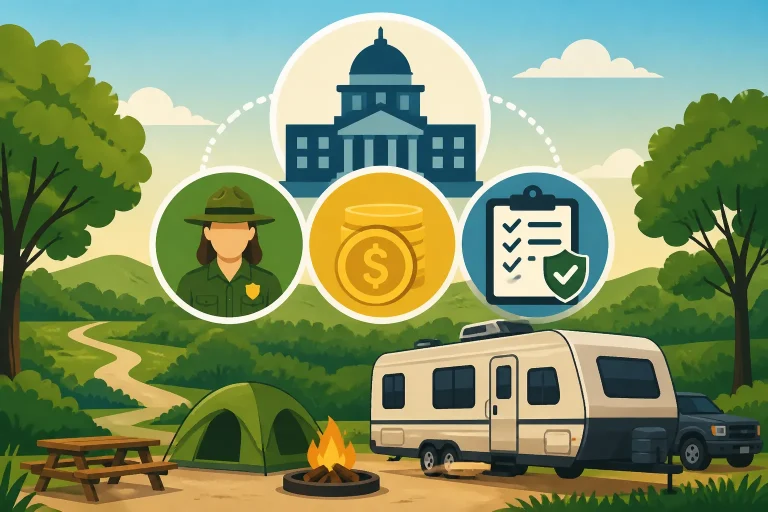
A motor vehicle permit is not the same thing as permission to camp at a particular location. Nor does having a campsite arrangement settle questions about the vehicles accompanying your group. Think of the trip as a few related but distinct decisions:
- What vehicles will enter the park, and what permit requirements apply to each?
- Are you planning a day visit, an overnight stay, or both?
- If staying overnight, are you choosing a campsite, cabin, or another option the park lists?
- What rules, restrictions, or closures apply to the specific park and area you plan to use?
When checking the cost of a trip, review the current information from the official provider for the vehicle permit and the overnight option you are considering. Look closely at what each charge covers rather than treating a payment as proof that every part of the trip is arranged. Permit options, reservation details, and costs can change, so use the official information for your planned visit.
A useful starting point is Vehicle Permits and Camping Fees at Kansas State Parks, Explained. For a broader comparison of state and federal pass questions, see Park Pass Basics for Kansas Visitors: State Permit or Federal Pass. These topics can help you frame the questions, but the current requirements for your visit should come from the responsible official source.
If your trip is only a day visit, do not book an overnight site just to solve a vehicle-permit question. If you intend to camp, do not treat a vehicle permit as a campsite booking. Keeping those tasks separate helps prevent a common planning mistake: arriving with one part of the trip settled and the other still uncertain.
Choose the kind of overnight stay that matches your trip
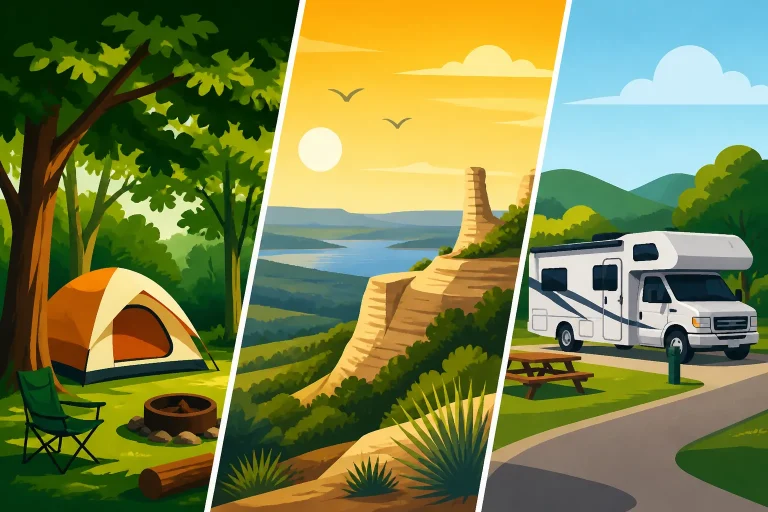
Kansas state parks may offer different ways to stay, but the options and details are not identical at every park. Start with how you plan to travel and what you need at the site. A tent trip, an RV trip, and a cabin stay have different equipment needs and different questions to settle before arrival.
| Stay type | A good fit when | Confirm before arranging the stay |
|---|---|---|
| Primitive campsite | You want a simpler camping setup and can manage with fewer conveniences | The exact location, what facilities are available, and what you need to bring |
| Utility campsite | You want a campsite with listed utility connections for your camping unit | The site’s specific services, layout, and suitability for your equipment |
| Cabin | You prefer an indoor place to sleep or do not want to bring a tent or RV | What the cabin provides, what you must bring, and the rules that apply to the rental |
These labels are a starting point, not a promise that every site with the same label has the same features. Read the listing for the specific park and site. If the description does not answer a practical question, check with the park through its official contact information before making plans.
Tent campers
A tent camper should look beyond the word “campsite.” Find out whether the option is intended for tent use, what the surface and surroundings are like, and whether any utilities or facilities are listed. Consider how you will handle drinking water, food, lighting, weather protection, and waste without relying on amenities that have not been confirmed.
Think about the whole setup, too. A site that works for a small tent may not suit a larger shelter, a vehicle parked close by, or a group that expects to spread out. Read the site description carefully and ask about anything the listing leaves unclear. Tent Camping in Kansas State Parks: Primitive Loops and Quiet Nights offers a useful way to think through the differences between tent areas.
RV and trailer campers
For an RV, trailer, camper van, or similar setup, verify that the listed site works for your particular unit. Check the site details provided by the park, including the type of utility service, if any, and whether the layout fits the way you camp. Do not rely on a broad label alone. A site described as a utility site might not offer the particular connections or arrangement you need.
Consider the parts of your rig that affect fit, such as its full length with towing equipment attached and any space needed to position it. If you use slide-outs or carry extra gear, consider whether the site description accounts for those needs. When the listing is not specific enough, ask the park before you commit. The articles Which Kansas State Park Site Fits Tent, Trailer or Cabin Campers? and Will Your RV Fit? Checking Kansas State Park Campsite Sizes cover the kinds of compatibility questions worth asking.
Cabin guests
A cabin can simplify a trip, but it does not necessarily include everything you expect to find there. Check the specific cabin listing for its amenities, sleeping arrangements, rules, and what guests should bring. If you need a particular feature, confirm it rather than inferring it from the cabin’s name or from another park’s listing.
Also consider whether the cabin suits everyone in your party. Think through sleeping arrangements, access needs, pets if relevant, and how you will manage meals and supplies. The rules for a cabin stay may differ from the rules for camping at a site, so review the applicable information for the actual rental. Choosing Between a Cabin and a Campsite at a Kansas State Park can help you weigh the two formats.
Camp only where the park allows
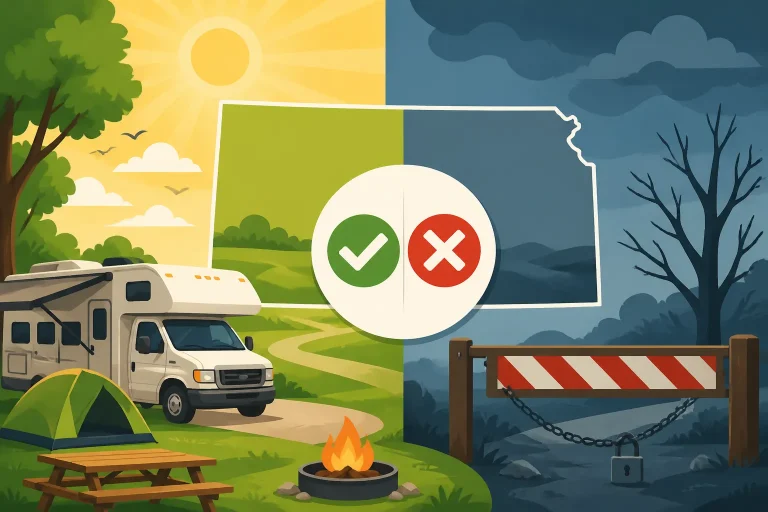
The place you choose matters as much as the kind of shelter you bring. The Kansas Department of Wildlife and Parks states that camping is allowed only in designated areas and is subject to restrictions as posted. In practical terms, do not assume that an attractive patch of shoreline, a quiet roadside pull-off, or an open-looking space is available for overnight camping.
Use the park’s official information to identify the designated camping areas and the specific site or loop you plan to use. Once you arrive, read signs and posted notices before setting up. A map or online description can help with planning, but it should not be treated as a substitute for restrictions posted at the park.
This matters especially when a park has several recreation areas, loops, or kinds of overnight facilities. A site’s proximity to a lake or trail does not establish that camping is allowed there. Stay within the area assigned or designated for camping, and follow any restriction that applies to the location. For more on where camping is permitted, see Designated Camping Areas: Where Kansas State Parks Let You Camp.
Before selecting a particular site, ask yourself:
- Is this location identified as an area where camping is allowed?
- Does the listing or posted information describe restrictions that affect my setup?
- Is the place I intend to occupy the site I arranged, rather than a nearby space that merely looks available?
- Are there signs or notices at the park that change what I planned to do?
These checks help prevent an appealing but unauthorized spot from turning into a problem. They also keep you from assuming that a site is available just because it is not occupied when you first see it. A site may be reserved, restricted, unsuitable for your camping unit, or intended for another use.
If the area you planned to use is closed or a posted restriction changes your options, pause and check with park staff or the official information source. Do not move to an unmarked area and assume that the same arrangement is permitted there. You can also review Posted Restrictions in Kansas State Parks: Reading Signs on Arrival when preparing to interpret notices at the park.
Arrange the stay and confirm who can rent
Once you have selected a park and the type of stay, read the official listing for the specific campsite or cabin. Confirm what you are arranging, what information is required, and what the current payment and change terms are. Do not rely on a description copied from a different site or an old trip plan. The official reservation system and park information are the places to verify current details.
According to the Kansas Department of Wildlife and Parks, a person renting a state park cabin or campsite must be 18 or older. If someone else in your group is handling the rental, make sure the person responsible meets the requirement and understands the arrangement. For group trips, decide in advance who will be the renter and who will communicate about changes or questions.
Read the reservation details with care before completing the arrangement. Check that the dates, park, site or cabin type, and party information are correct. Review the instructions about arrival, check-in, changes, and cancellation as presented by the official provider. Those details can affect what to do if travel runs late or plans shift.
Do not assume that an online listing answers every practical question. If you need to know whether a specific camping unit fits, whether a particular amenity is available, or how to handle an unusual arrival, ask the park or reservation provider before setting out. Keep the confirmation and any relevant instructions accessible during travel.
For help understanding the booking process, see Booking a Kansas State Park Campsite: Accounts, Payment and Renters. If you are unsure what information to have ready at arrival, What to Have Ready When You Check In at a Kansas State Park Campground is a useful companion.
Make a practical plan for arrival
Before leaving, confirm the route to the park and the location of the area where you intend to stay. Check official updates for closures or changes that could affect access. If you expect to arrive outside normal office service, look up the park’s current instructions instead of assuming that check-in will work the same way everywhere.
Bring the information needed to identify your arrangement, along with the vehicle-permit details relevant to your group. If several vehicles are traveling, communicate the plan to everyone who will enter the park. If your group is splitting up, agree on where to meet and how to handle changes without relying on a weak or unavailable cell connection.
If the site is not as described or a sign conflicts with your expectation, stop and resolve the question before unloading. Staff or official park information can clarify what applies. A small pause at arrival is easier than setting up in a location that turns out to be unavailable or restricted.
Read park rules and posted notices before you settle in
A state park is not simply a campsite with open space around it. Visitors may travel on park roads, use day-use areas, visit beaches, bring pets, or make a fire, and each activity can have its own restrictions. Start with the rules that apply to your planned activities, then read posted notices when you arrive. Do not assume that a rule you remember from another park applies in the same way at this one.
The official park information and posted signs should guide decisions about where to drive, where to park, what activities are permitted, and how to use facilities. If you are not sure whether a rule applies to your situation, ask the park through its official contact details. Avoid relying on a secondhand account when the question affects safety, access, or whether an activity is allowed.
Driving and parking
Follow signs and stay on roads and in parking areas intended for vehicles. Plan where you will park before arriving, especially if your group has a trailer or more than one vehicle. A campsite reservation does not by itself answer every parking question, so check the information for the specific area and follow any restrictions posted there.
When moving through the park, drive with care around people walking, cycling, or using recreation areas. If you need to leave a vehicle temporarily, use an appropriate parking area rather than assuming that any open shoulder or nearby ground is available. Vehicles in Kansas State Parks: Permits, Roads and Parking Areas and Parking Rules Inside Kansas State Parks for Cars and Trailers provide more detail on these issues.
Fire and cooking plans
Do not decide that a campfire is permitted based only on seeing a fire ring or on what another visitor is doing. Fire restrictions can change, and rules can depend on the place and current conditions. Check the applicable official information before leaving and again when you arrive. Follow posted notices, and choose a non-fire cooking plan if you cannot confirm that your intended fire use is allowed.
If fires are permitted under the rules that apply to your site, use only the location and method allowed there. Keep cooking equipment and fuel under control, and do not leave a fire unattended. Before departing the site, follow the applicable instructions for leaving the area safe. For related planning, see Kansas State Park Campfire Rules: Where Fires Are Allowed and Checking a Kansas State Park Campfire Rule Online and on Arrival.
Pets, swimming, and shared areas
If you are bringing a pet, verify where pets are allowed and what restraint rules apply. Do not assume that a pet may accompany you into every building, beach, or shared space. Plan for the pet’s comfort and safety, and be ready to adjust your route if an area is off-limits.
For swimming, use the park’s designated information and posted signs. Do not treat a shoreline as an open swimming area just because it looks accessible. Check what applies to the particular beach or water access point, and keep children and pets within the areas and conditions that the park permits.
Shared areas work best when visitors leave room for others and respect posted instructions. Keep noise and equipment within the applicable rules, avoid blocking access, and leave the area in good condition. For the broader park rules, Rules Inside Kansas State Parks, From Speed Limits to Campfires is a useful reference. Pet owners can also consult Pets in Kansas State Parks: Leashes, Tethers and Off-Limits Spots.
Prepare for changing conditions and park updates
A good trip plan includes a way to adapt. Weather, access, site conditions, and operating information can affect what you do, so check for official updates before traveling. If conditions change after you leave, check again when you reach the park. A saved plan is useful, but it should not override a current closure notice or a restriction posted at the site.
Look up the park’s current operating information before setting out, especially if your plans depend on a particular facility or route. A campground, beach, trail, or other feature may have different availability from what you expect. Check Is Your Kansas State Park Open? Checking Closures and Updates and Where Kansas State Parks Post Operating Updates for guidance on where to look.
Prepare for weather based on the activities you have planned. For tent camping, think through how you will keep sleeping gear dry and secure your shelter if wind or rain arrives. For an RV trip, consider the driving conditions and whether your campsite layout will remain workable in poor weather. For a cabin stay, have a backup plan for outdoor activities if conditions make them uncomfortable or unavailable.
You do not need to pack for every possible event, but you should avoid depending on a single fragile plan. Bring the essentials for your chosen stay, keep important items protected, and know what you would do if you needed to wait out bad weather or change an activity. A campsite with limited conveniences calls for more self-sufficiency than a stay where the listing confirms the facilities you need.
Fire conditions deserve a separate check. Fire bans and restrictions can change, and a notice from an earlier date may no longer describe the situation when you travel. Check official information before leaving and again when you arrive, then follow the current posted instructions. Do not infer that a fire is allowed because the trip was planned around one or because fire equipment is present at the campsite.
Consider communications as well. Mobile service may not be dependable everywhere, so save essential reservation and park details before you travel. Tell your group what to do if plans change and people are separated. If you need current contact details, use the park’s official website rather than relying on an old note or an unofficial listing.
Use a simple planning sequence for your first visit
First-time trips are easier when you work through decisions in a deliberate order. The following sequence keeps permits, lodging, site choice, and park rules from blending into one assumption.
- Choose the park and purpose of the visit. Decide whether you are planning a day outing, an overnight stay, or both. Identify the activities that matter most, then check whether the park’s information supports those plans.
- Select the kind of stay. Compare a tent site, utility site, or cabin according to your equipment and comfort needs. Confirm the details for the specific option rather than relying on a general category.
- Check the location. Make sure the area you intend to use is designated for camping if you are staying overnight. Review the site description and any restrictions.
- Arrange the overnight option. Use the official system to verify availability, renter eligibility, payment details, and the terms that apply to the arrangement.
- Handle vehicle permits separately. Account for every motorized vehicle entering the park. Check the current permit information for the vehicles in your group.
- Review activity rules. Look up the requirements that matter for your plans, such as driving, parking, pets, swimming, or fires.
- Check for updates. Look for closures and changing restrictions before departure and again when you arrive.
- Pack for the specific stay. Bring what the official listing confirms is not supplied, along with essentials for the weather and activities you expect.
- Recheck signs at the park. Follow posted instructions even if they differ from what you anticipated based on an older plan.
This sequence is deliberately practical rather than rigid. You may need to revisit a choice if the site does not fit your equipment or if a closure affects your plan. The important point is to verify each part through the right source instead of expecting a single reservation or permit to answer every question.
For a first overnight trip, a concise packing check can prevent avoidable surprises. Confirm that you have the shelter and sleeping gear appropriate to the site, clothing for changing conditions, food and water suited to your plan, lighting, and the supplies needed to clean up after yourself. Match the list to the site’s actual amenities; do not pack on the assumption that a facility will be available unless the park confirms it. Packing List for a First Night at a Kansas State Park and Camping Gear Kansas State Parks Do Not Supply can help refine that list.
After arrival, take time to orient yourself before unpacking everything. Locate the site or cabin, read the posted information, and make sure your vehicle is parked where permitted. If you have a question about a restriction or the boundaries of the camping area, resolve it before setting up. A calm check at the start can save time and reduce confusion for the rest of the stay.
Frequently Asked Questions
Does a vehicle permit reserve a campsite?
No. Treat vehicle entry and overnight arrangements as separate planning tasks. Confirm the permit requirements for the vehicles in your group and arrange a campsite or cabin separately through the official information for the park.
Can I camp wherever I find an open-looking spot?
No. Camping is limited to designated areas, and posted restrictions apply. Confirm the location through official park information and follow notices at the park.
How can I tell whether a campsite will fit my tent or RV?
Read the listing for the specific site and compare its details with your equipment. If the description does not settle a practical fit question, ask the park before finalizing your plan.
What should I do if a sign conflicts with my plans?
Follow the posted restriction and check with park staff or the official information source before choosing another location or activity. Do not assume that a nearby unmarked area is an acceptable substitute.
Sources
- Kansas Department of Wildlife and Parks — Kansas State Park Rules and Regulations | Kansas Department of Wildlife and Parks – Kansas Parks and Tourism (checked November 24, 2026)
Disclaimer
This article is for general informational purposes only and does not constitute professional advice. Laws, prices and regulations vary by location and change over time. Consult a qualified professional for guidance on your specific situation. Kansas Camping & RV is not a government agency and is not affiliated with any government agency.